



.svg)


Strategic Decarbonization Starts at the Envelope
Strategic decarbonization starts at the building envelope. See how SIPs cut embodied and operational carbon with verified,..
.png?width=555&height=74&name=Tested.%20Proven.%20PREMIER%20(1).png)
Part 2 of the Proof in Performance Series – Showing That SIPs Save Energy and Time
Talk is cheap, unless it’s backed by data. Just like structural strength, energy efficiency must be proven. In this second installment of our Proof in Performance blog series, we dive into scientific studies and lifecycle analyses showing how SIPs outperform traditional building envelopes in energy savings, carbon impact, and long-term sustainability.
Let’s examine the third-party research that explains why SIPs deliver measurable thermal performance and efficiency.
>> Read Proof in Performance, Part 1: Why SIPs are Stronger by Design.
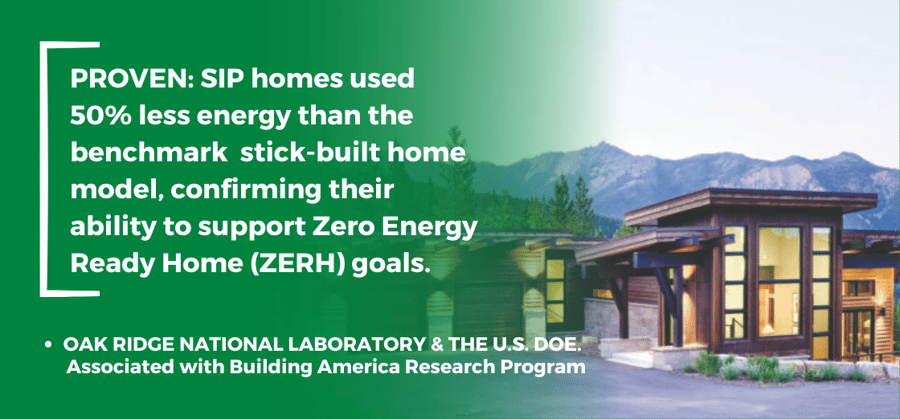
1. ORNL: High Performance Homes That Use 50% Less Energy Than DOE Benchmark
As part of the Department of Energy’s Building America research program, this ORNL study analyzed SIP-built homes designed to cut energy usage in half compared to the DOE benchmark.
What it studied: Performance of SIP homes vs. conventional stick-built homes in mixed-humid climates.
Key takeaway: SIP homes used 50% less energy than the benchmark model, confirming their ability to support Zero Energy Ready Home (ZERH) goals.
Backed by Oak Ridge National Laboratory and the U.S. DOE.
⇒ Read the ORNL 50% Energy Savings Study
2. ORNL/Building America: 40% Energy Savings in Mixed-Humid Climate
Another Department of Energy-backed study through ORNL and Building America explored how SIPs contribute to deep energy savings in Tennessee’s climate.
What it studied: Energy usage, HVAC loads, and airtightness of SIP homes compared to traditional framing.
Key takeaway: SIP homes used 40% less energy and required 40% smaller HVAC systems—plus delivered airtightness as low as 0.8 ACH50.
Supported by Building America program through the DOE.
⇒ Read the 40% Energy Savings Study
3. BASF: Eco-Efficiency Analysis of Residential Wall Systems
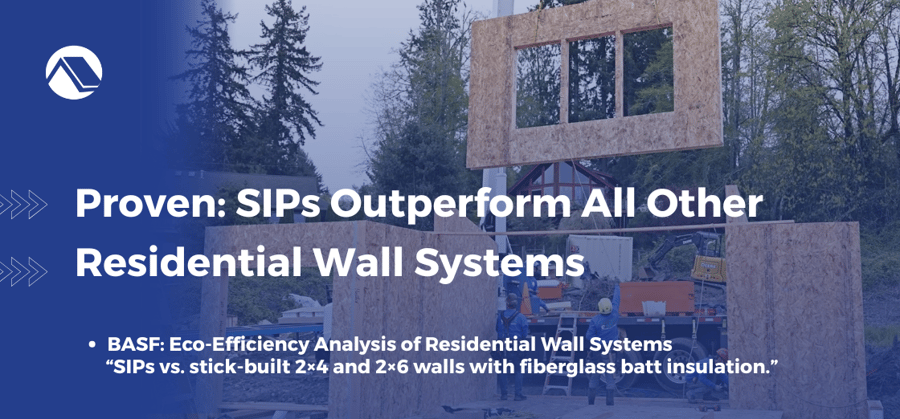
This award-winning study compared several residential wall systems across their entire lifecycle—from material sourcing to long-term performance and environmental impact.
What it studied: SIPs vs. stick-built 2×4 and 2×6 walls with fiberglass batt insulation.
Key takeaway: EPS and polyurethane SIPs outperformed all others in energy efficiency, lifecycle emissions, and environmental impact.
Commissioned by BASF using full lifecycle analysis.
⇒ Read the BASF Eco-Efficiency Study
4. Buildings Journal: Life Cycle Cost Analysis in Hot and Arid Climates
Researchers from the University of Melbourne and the University of Belgium evaluated SIPs in extreme heat climates to assess their total cost of ownership.
What it studied: Construction costs, operational energy, and ROI of SIPs vs. wood framing in Phoenix, AZ.
Key takeaway: SIPs provided lower lifetime costs, higher energy efficiency, and better climate resilience.
Peer-reviewed and published in the Buildings journal.
⇒ Read the Full SIPs Life Cycle Analysis Study
SIPs aren’t just a smart structural choice; they’re a proven path to high-performance energy savings. Whether you're designing for a hot, arid climate or aiming for net-zero goals in a mixed-humid zone, third-party research confirms what builders already know: SIPs help reduce operational energy, slash HVAC needs, and deliver measurable performance where it counts.
Want more? Head to the Premier SIPS Resource Portal to explore full studies, test data, technical documents, code reports, and more. Contact your local Premier SIPS Rep to discuss getting started with energy-efficient SIPs for your next construction project.
How do Structural Insulated Panels (SIPs) improve energy efficiency?
Structural Insulated Panels (SIPs) improve energy efficiency by integrating structure, insulation, and air control into a single engineered panel. This reduces air leakage, minimizes thermal bridging, and creates a more continuous building envelope compared to traditional stick framing.
Are SIP homes more energy efficient than conventional framing?
Yes. Independent third-party research, including studies from Oak Ridge National Laboratory (ORNL) and the U.S. Department of Energy Building America program, has shown that SIP-built homes can use up to 40–50% less energy than comparable stick-framed homes in certain climates.
Why does airtightness matter for energy savings?
Uncontrolled air leakage increases heating and cooling loads. SIP systems are designed to reduce air leakage at the structural level, which lowers energy demand and improves overall building performance. Some tested SIP homes have achieved airtightness levels as low as 0.8 ACH50.
Do SIPs reduce HVAC system size?
Yes. Because SIP buildings experience lower heating and cooling loads due to improved insulation continuity and reduced air leakage, HVAC systems can often be sized smaller. DOE-backed research has documented reductions of up to 40% in HVAC system size.
How do SIPs reduce thermal bridging?
Traditional framing interrupts insulation with wood studs, which conduct heat. SIPs use a continuous rigid insulation core with minimal structural interruptions, significantly reducing thermal bridging and improving whole-wall performance.
Are SIPs suitable for hot or extreme climates?
Yes. Peer-reviewed lifecycle cost studies in hot and arid climates, such as Phoenix, Arizona, have shown that SIP construction delivers lower lifetime energy costs and improved operational performance in extreme heat conditions.
Do SIP buildings qualify for Zero Energy Ready Home (ZERH) goals?
Yes. Research conducted through the DOE Building America program has shown SIP homes achieving performance levels that support Zero Energy Ready Home targets due to reduced energy demand and improved airtightness.
Is energy efficiency from SIPs dependent on additional air-sealing systems?
No. While proper detailing and sealing are still important, SIPs are engineered to integrate insulation and air control within the panel system itself. This reduces reliance on secondary interior air-sealing measures.
What is the typical ACH50 result for a SIP home?
While results vary by project and installation quality, SIP structures commonly achieve significantly lower ACH50 results than conventional framing, with some documented cases reaching 0.8 ACH50 in DOE-backed studies.

Premier SIPS deliver a high-performance building envelope that outperforms traditional framing in efficiency, strength, and long-term durability. If you're evaluating SIPs, planning an upcoming project, or ready for pricing, now is the time to talk with our team about the right next step.
