Designing for Consistency in an Inconsistent Labor Environment
Labor conditions vary from job to job. Learn how systems-based design supports consistent building performance despite..
Why efficiency, resilience, and predictability will define the next generation of building—and where SIPs fit in.
The 2026 construction market is taking shape against a backdrop of shifting market forces: rising performance expectations, tightening labor availability, fluctuating costs, and growing pressure to electrify and reduce carbon.
Demand isn’t disappearing, but the rules of the game are changing. Builders, architects, and developers who adapt early will gain a competitive advantage before the industry fully feels the impact of these shifts.
This 2026 Construction Outlook breaks down the major forces influencing design and construction teams—and offers clear guidance for how architects, builders, and developers can navigate the year ahead with greater certainty.
Explore High-Performance Envelope Strategies for 2026
⇒ SIPs 101 for Design & Construction Teams
⇒ Proof in Performance Series
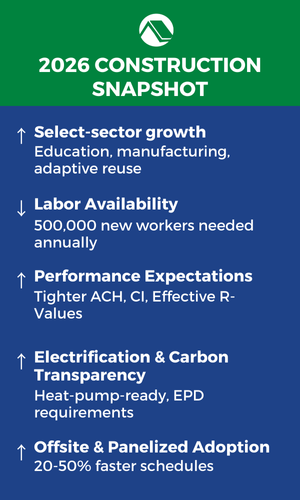
While the industry isn’t heading into a boom year, it is heading toward targeted growth. According to Dodge Construction Network, FMI, and NAHB forecasts, 2026 will be shaped by sector-specific expansion rather than broad-based growth.
 Where demand is increasing:
Institutional & public buildings (education, civic, public safety): Aging facilities, federal funding, and community infrastructure needs are accelerating construction in this category.
Manufacturing & industrial construction: States continue to push reshoring incentives, expanding factories, distribution centers, and high-tech facilities.
Single-family housing: NAHB forecasts steady recovery as mortgage rates ease, especially in markets with chronic housing shortages.
Renovation & adaptive reuse: With limited availability of new land and rising building costs, adaptive reuse continues to gain traction.
Why this matters for project teams:
Projects that demand speed, energy efficiency, resilience, and predictability, like schools, multifamily, community buildings, and modular-friendly projects, will drive the most volume. These project types directly benefit from panelized, off-site, and high-performance envelope systems.
For design teams, this shift toward sector-specific growth increases the value of repeatable, high-performance envelope solutions that can be adapted across schools, multifamily, civic, and light-industrial projects—reducing redesign cycles while maintaining performance targets.
Sources:
The construction labor shortage is not expected to improve in 2026, if anything, it will tighten.
Source: 2026 Engineering & Construction Outlook (Deloitte)
Impact on 2026 projects:
Builders will face:
What this means for planning:
Construction teams will need to prioritize systems that reduce onsite labor dependency, decrease sequencing issues, and shorten critical-path timelines. Offsite construction and panelized building solutions will continue to rise, not as trends, but as a workforce reality.
For architects and engineers, labor constraints increasingly influence detailing decisions, constructability reviews, and envelope complexity. Systems that reduce trade coordination, simplify sequencing, and limit field variability help design teams protect intent while avoiding late-stage redesigns or substitutions.
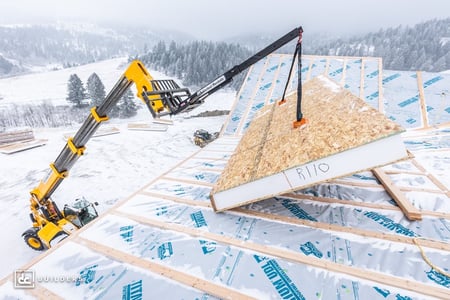
Offsite and panelized construction is no longer an emerging trend—it has become a standard strategy for project teams seeking earlier certainty, tighter coordination between design and construction, and reduced reliance on field labor.
What the research confirms:
McKinsey reports a sharp acceleration in industrialized construction, fueled by escalating labor costs, tighter project timelines, and advances in digital design and manufacturing.
Dodge Construction Network’s Prefabrication & Modular Construction SmartMarket Report shows that builders using offsite methods routinely achieve 20–50% reductions in construction schedules.
The World Economic Forum (2025) identifies offsite and panelized construction as essential to improving productivity, reducing material waste, and scaling faster project delivery across the global construction industry.
For design teams, panelization shifts critical decisions upstream—allowing performance, detailing, and constructability to be resolved earlier, when changes are less costly and more impactful.
So What Does This Mean for Design & Construction Teams in 2026?
Project teams who rely on traditional framing, insulation and sheathing methods may experience:
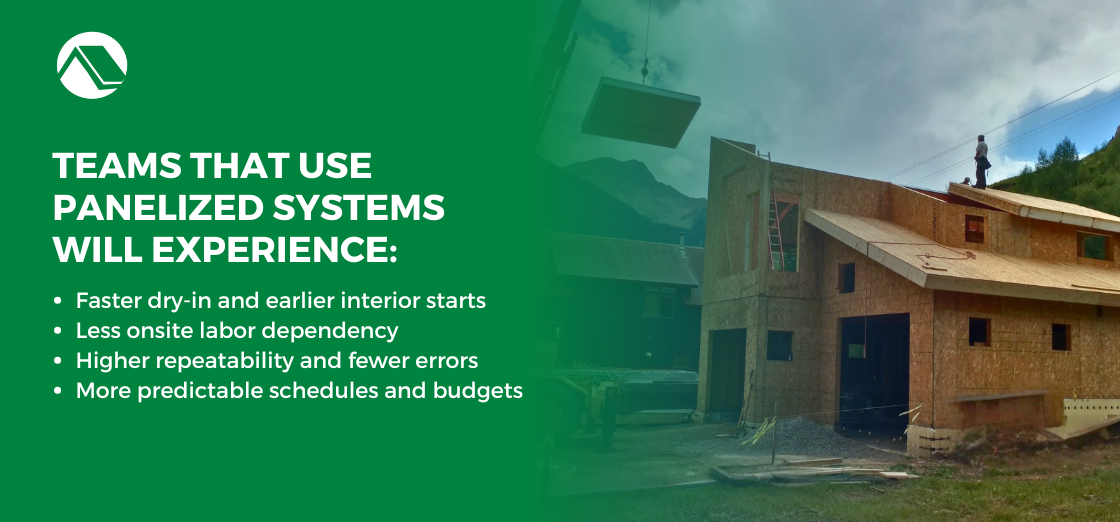
Meanwhile, teams using panelized systems will experience:
Offsite precision + onsite speed will define the most profitable projects in 2026. Panelized systems like SIPs sit at the center of this shift, offering builders a proven way to improve labor efficiency, performance, and schedule certainty.
Sources:
See How Panelized SIPs Improve Speed, Certainty & Performance
⇒ Building With Confidence: Power of Predictability
⇒ Streamline Building Projects to Alleviate Labor Shortages
Unlike past cycles, 2026 won’t be driven by a single federal mandate; it will be shaped by state-level tightening and market demands.
Key performance areas increasing across the country:
.jpg?width=441&height=331&name=Resized_R%20(1).jpg) California & Washington lead the movement
California & Washington lead the movement
Both states are implementing performance tiers that exceed the 2024 IECC in:
These states influence national manufacturers, designers, and builders for years afterward, and often forecast national trends.
Source:
Washington State Building Codes (State Building Code Council)
Designing for Code, Carbon & Electrification?
⇒ SIPs & Continuous Insulation (Ci) Explained
⇒ Maximize HVAC Efficiency with High-Performance Envelopes
Across 2024–2025, materials markets experienced volatility driven by:
While prices may fluctuate month to month, the more important trend is unpredictability.
Why predictability will matter most in 2026:
Owners and lenders are demanding:
Systems that minimize variables—fewer labor steps, fewer trades, fewer field modifications—will become the preferred choice for developers and GC’s aiming to protect profit margins.
Source:
2026 will see major growth in health-driven construction requirements.
The biggest shifts:
Why this matters:
Owners are beginning to ask: "What does this building do for the people living or working inside it?" Products with health certifications and clean, verified emissions data increasingly win the specification.
Source:
Construction teams will need strategies that:
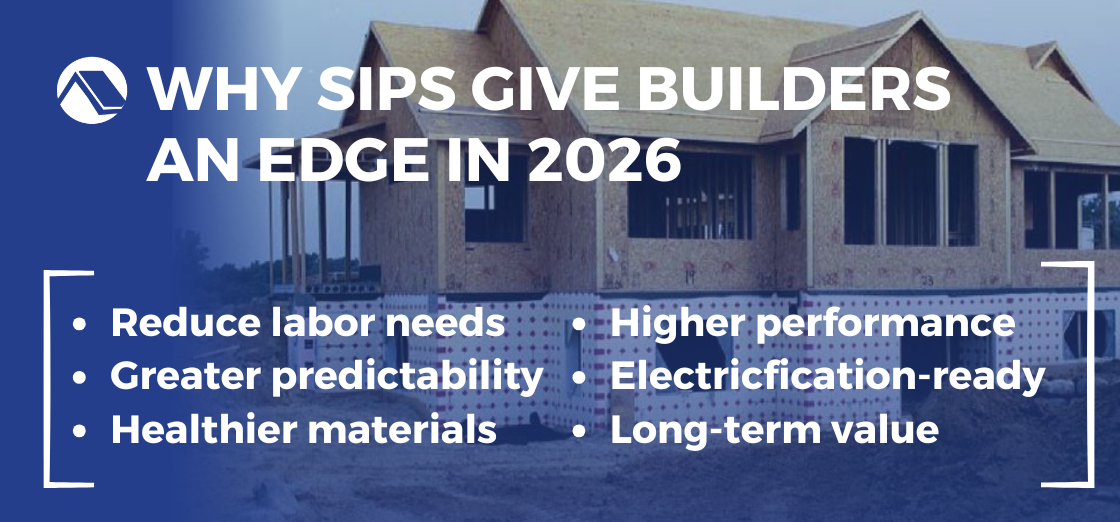
Traditional framing struggles under these demands. High-performance, panelized envelope systems, like Structural Insulated Panels (SIPs), meet them naturally.
|
SIPs Advantage |
Why It Matters in 2026 |
|
Reduce Labor Needs |
SIPS reduce labor dependency with:
|
|
Improve Building Performance |
SIPS help meet rising energy, code and performance expectation with:
|
|
Increase Predictability |
SIPs improve predictability through:
|
|
Support Electrification |
SIPs lower operational carbon & HVAC loads:
|
|
Meet Health & IAQ Requirements |
SIPs support healthy-building initiatives and healthier indoor environments with:
|
|
Deliver Long-Term Value |
SIPs buildings satisfy owner's desire for long-term value because they offer:
|
 The coming year’s challenges—labor scarcity, energy expectations, performance requirements, cost volatility—aren’t temporary. They are the new reality.
Teams that adopt smarter systems now will:
Systems like SIPs don’t just help projects meet 2026 requirements—they help design and construction teams stay ahead of what’s coming next.
⇒ Connect with a Premier SIPs Advisor today to discuss what SIPs can do for your upcoming design and construction projects.

Premier SIPS deliver a high-performance building envelope that outperforms traditional framing in efficiency, strength, and long-term durability. If you're evaluating SIPs, planning an upcoming project, or ready for pricing, now is the time to talk with our team about the right next step.
