If you ask five people on a jobsite which insulation is "best," you’ll get five different answers, and all five will be defending the number on a spec sheet. That number, the R-value per inch printed on the packaging, is the least useful piece of information for predicting how a material will actually perform in a wall or roof assembly for the next 30 years.
Insulation is one of the most consequential decisions in a building envelope. It gets specified early, poured or laminated or blown in once, and then buried behind drywall or siding for the life of the structure. Nobody opens the wall in year 12 to check on it. So the properties that matter, whether the R-value printed on day one is still there in year 15, whether the material sheds water or hoards it, whether it contributes structurally or just fills a cavity, get decided once and lived with for decades.
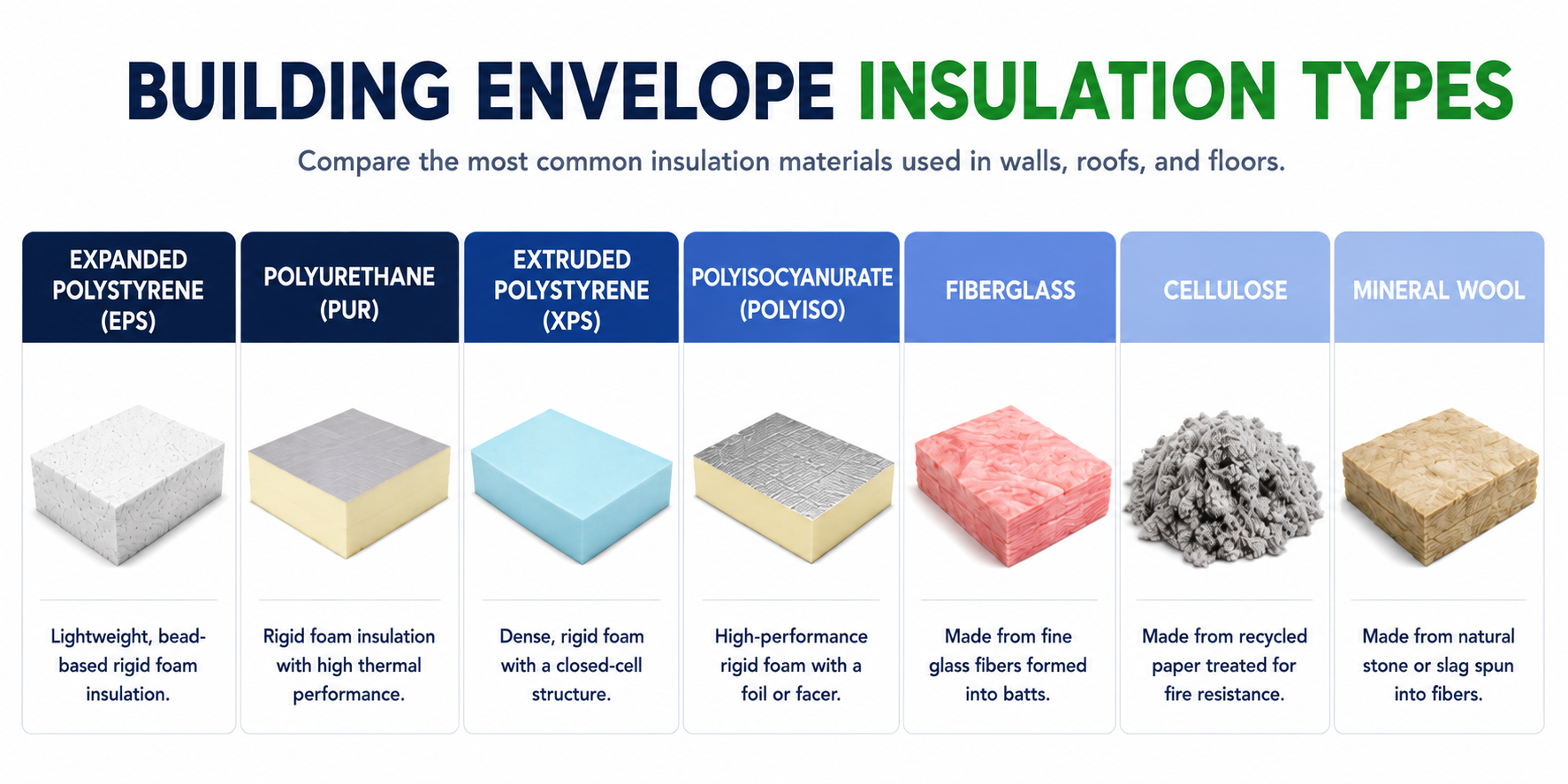
This guide breaks down the seven insulation materials most commonly specified in building envelopes today: expanded polystyrene (EPS), polyurethane (PUR), extruded polystyrene (XPS), polyisocyanurate (polyiso), fiberglass, cellulose, and mineral wool. We compare them on the properties that determine long-term performance, not just the label.
Key Takeaways
- Seven materials dominate building envelope insulation today: EPS, PUR, XPS, polyiso, fiberglass, cellulose, and mineral wool.
- Initial R-value per inch and long-term R-value are not the same number. Foam insulations that rely on a gas blowing agent (PUR, XPS, polyiso) lose some R-value over time, a documented phenomenon called thermal drift.
- EPS and mineral wool do not experience thermal drift; their insulating value comes from trapped air or inert mineral fiber rather than a diffusing gas.
- Polyiso retains roughly 90 to 95% of its labeled R-value long-term (per NRCA and LTTR testing), but loses meaningful performance in cold temperatures, up to 25 to 30% below roughly 50°F.
- Mineral wool has the strongest fire performance of the seven; fiberglass fibers are also non-combustible, though foam plastics are not.
- None of the seven materials is structural on its own. EPS is the exception when laminated as a SIP core, where it becomes part of a load-bearing composite panel.
- Cellulose has the highest recycled content (75 to 85%); EPS is 100% recyclable and carries the lowest cost per R-value of the rigid foams.
Short Answer
The seven major building envelope insulation types are EPS, PUR (polyurethane), XPS, polyiso, fiberglass, cellulose, and mineral wool. They differ most in four ways: whether their R-value holds steady or drifts downward over time, how they behave when exposed to moisture, whether they contribute any structural strength to the assembly, and how they perform at end of life.
No single material wins on every category. The right choice depends on climate, application (above-grade wall, below-grade, roof), moisture exposure, and whether the assembly needs the insulation to also serve a structural role.
Why R-Value on the Label Isn’t the Whole Story
Every insulation product ships with a printed R-value per inch. That number is measured under controlled lab conditions, usually shortly after manufacturing, at a specific test temperature. It is a real number. It is also not the number you’ll be living with in year 10.
Two things happen to insulation after it leaves the factory that the label doesn’t capture:
Thermal drift. Not all foam insulations behave the same way here, and this is where EPS is easy to misclassify. EPS is a foam, but its cells fill with ordinary air during manufacturing rather than retaining a specialized low-conductivity gas, so there’s nothing left to leak out over time. PUR, XPS, and to a lesser degree polyiso are different: they’re closed-cell foams that trap a blowing agent gas that conducts heat more slowly than air, which is exactly where their higher initial R-value comes from. Over years, that gas slowly diffuses out and is replaced by ordinary air, which conducts heat faster. The R-value declines. Building Science Corporation and the Oak Ridge National Laboratory’s Long-Term Thermal Resistance (LTTR) protocol (CAN/ULC-S770, based on ASTM C1303) both exist specifically to measure this decline, because the day-one number was found to overstate real-world performance badly enough that the roofing industry adopted an entirely separate aged-value standard for polyiso in 2003.
Moisture uptake. Insulation that absorbs and holds water conducts heat faster than dry insulation, full stop. This matters most below grade, in slab-on-grade applications, and in any assembly where the material sits against damp soil or concrete for years at a time.
Neither factor shows up on a spec sheet’s headline number. Both are why "highest R-value per inch" and "best insulation" are not the same question.
Complete Comparison Table: All 7 Insulation Types
| Building Envelope Insulation: 7-Material Comparison |
| Property |
EPS |
PUR |
XPS |
Polyiso |
Fiberglass |
Cellulose |
Mineral Wool |
| Initial R-Value/in |
R-3.6 to R-4.2 |
R-6.0 to R-7.0 |
R-5.0 to R-5.2 |
R-5.6 to R-6.8 |
R-2.2 to R-4.3 |
R-3.2 to R-3.8 |
R-3.0 to R-4.3 |
| Long-Term R-Value |
✓ Stable, no drift |
Drifts to ~R-5.0–R-6.5 |
Drifts 5–10% + moisture losses below grade |
Retains ~90–95% (foil-faced); drops in cold temps |
Stable material, but field-installed value often below rated |
Stable material; settling reduces effective coverage |
✓ Stable, no drift |
| Moisture Resistance |
✓ High, low absorption, dries out |
High, closed-cell |
Good above grade; absorbs over time below grade |
Good with intact facing; low drying potential |
Poor; absorbs readily |
Moderate; hygroscopic, can saturate |
✓ High, hydrophobic |
| Vapor Permeance |
Class III, permeable, allows drying |
Very low, acts as vapor barrier |
Low, limited drying |
Very low with facing |
Permeable |
High, breathable |
Moderate |
| Fire Resistance |
Combustible, treated/self-extinguishing |
Combustion-resistant thermoset, toxic smoke |
Combustible |
Combustible, better performance than PUR/EPS |
✓ Non-combustible fibers |
Combustible, borate-treated |
✓ Non-combustible, highest heat tolerance |
| Structural Contribution |
✓ Structural as SIP core when laminated |
None alone; structural as laminated core |
None |
None; board only |
None |
None |
None |
| Sustainability/Recyclability |
✓ 100% recyclable, low embodied energy |
Not melt-recyclable, isocyanate chemistry |
Higher embodied carbon (blowing agent GWP) |
Not readily recyclable |
20–30% recycled content |
✓ 75–85% recycled content |
✓ ~70% recycled content |
| Relative Cost |
✓ $, most cost-effective rigid foam |
$$$$ |
$$ |
$$ |
$ |
$ |
$$ |
Here’s what’s actually driving each material’s numbers.
The Seven Major Insulation Types
EPS (Expanded Polystyrene)
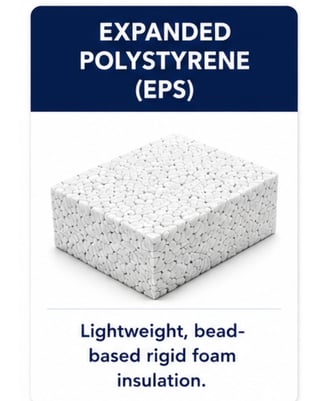 EPS is a closed-cell foam made by expanding polystyrene beads with steam, resulting in a material that’s roughly 95 to 98 percent trapped air by volume. It’s the most widely used rigid foam insulation in North America and the standard core material in most structural insulated panels (SIPs).
- Initial R-value: R-3.6 to R-4.2 per inch (graphite-enhanced GPS reaches R-4.7 to R-5.1 per inch)
- Long-term stability: EPS has no blowing agent to lose, its insulating value comes from trapped air, so it doesn’t experience thermal drift. A 15-year in-situ field study by the EPS Industry Alliance found EPS retained 94% of its rated R-value after 15 years buried below grade, while side-by-side XPS retained only about half.
- Moisture behavior: Closed-cell and dimensionally stable; low water absorption by volume, and it dries out rather than holding water indefinitely.
- Fire: Combustible without treatment. EPS used in construction is manufactured with flame-retardant additives and is self-extinguishing when the ignition source is removed. It melts before it burns.
- Structural role: None on its own. As the laminated core of a SIP, bonded under pressure between OSB skins, it becomes part of a load-bearing composite panel.
- Sustainability: 100% recyclable, manufactured from polystyrene beads, air, and steam with no HFC or HCFC blowing agents. Low embodied energy.
- Relative cost: $, the most cost-effective rigid foam per R-value delivered over the life of the building.
PUR (Polyurethane)
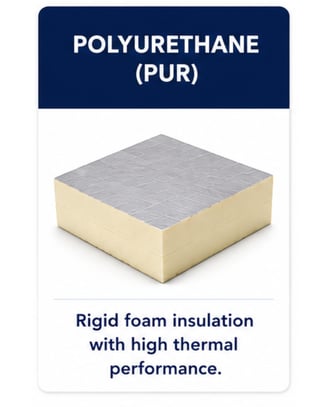 Polyurethane foam, whether spray-applied or used as an unfaced rigid core, is a thermoset plastic produced by reacting isocyanates (MDI or TDI) with polyols, expanded with a chemical blowing agent.
- Initial R-value: R-6.0 to R-7.0 per inch, the highest of the seven materials on day one.
- Long-term stability: This is where PUR gives back some of its initial advantage. Because it typically isn’t protected by a foil facer the way roofing polyiso is, its blowing agent diffuses out faster. Industry data generally puts aged PUR performance in the R-5.0 to R-6.5 per inch range, a real decline from the label, though it typically still outperforms EPS on a per-inch basis even after aging.
- Moisture behavior: Closed-cell structure resists water well and can function as its own vapor barrier, which limits how much drying potential a compromised assembly has if water does get in.
- Fire: A thermoset plastic that doesn’t melt, but PUR combustion produces toxic off-gassing, including isocyanate-derived compounds. Like all foam plastics, it requires a code-mandated thermal barrier (typically gypsum) in occupied assemblies.
- Structural role: None on its own; contributes to composite strength only when laminated between structural facings, similar to EPS.
- Sustainability: Its thermoset chemical structure means it can’t be melted down and reprocessed the way EPS can. Most end-of-life PUR is landfilled or incinerated, and manufacturing requires reactive isocyanates that carry their own handling and regulatory scrutiny.
- Relative cost: $$$$, the highest cost per board-foot of the seven.
XPS (Extruded Polystyrene)
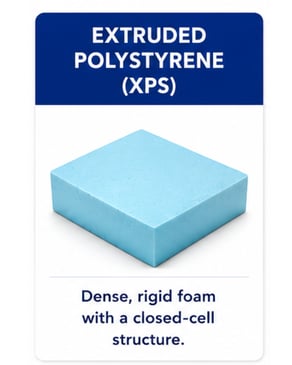 XPS is also a polystyrene foam, but it’s manufactured through a continuous extrusion process that produces a denser, more uniform closed-cell structure than EPS. It’s the pink or blue board familiar from big-box stores.
- Initial R-value: R-5.0 to R-5.2 per inch.
- Long-term stability: XPS uses a blowing agent (historically HFC-based) that diffuses out over time, producing a documented decline of roughly 5 to 10 percent from aging alone. The bigger issue is moisture: field studies on below-grade XPS have found water absorption significant enough to reduce real-world thermal performance well beyond what aging alone would predict, with losses reported as high as 44% in prolonged slab-on-grade exposure, per Oak Ridge National Laboratory’s 2012 review of long-term foam insulation performance. Above-grade, sheltered from standing water, it performs much closer to its rated value.
- Moisture behavior: Good initially, but XPS is more prone to long-term water uptake below grade than EPS, a well-documented finding in building science literature and one specifiers should weigh carefully for foundation and under-slab applications.
- Fire: Combustible; requires a code-compliant thermal barrier like the other foam plastics.
- Structural role: None; typically used as continuous exterior insulation or below-grade insulation rather than as a laminated structural core.
- Sustainability: XPS has historically carried the highest embodied carbon of the common rigid foams, largely because of its blowing agent’s global warming potential. Newer low-GWP formulations (driven by EPA phase-down rules) are closing that gap but haven’t eliminated it.
- Relative cost: $$, more expensive than EPS, less than PUR or polyiso.
Polyiso (Polyisocyanurate)
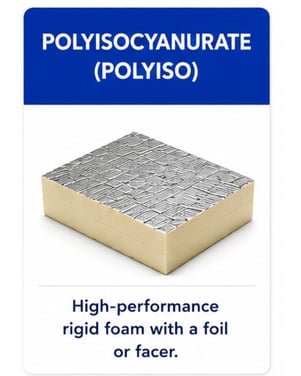 Polyiso is a chemical cousin of PUR, but formulated with a trimerized isocyanurate structure that gives it better fire performance and, when foil-faced, better long-term R-value retention than unfaced PUR. It’s the dominant insulation in commercial roofing.
- Initial R-value: R-5.6 to R-6.8 per inch.
- Long-term stability: This is a case where the marketing shorthand ("foam loses R-value, EPS doesn’t") oversimplifies. Independent LTTR testing (CAN/ULC-S770) shows foil-faced polyiso typically retains 90 to 95 percent of its labeled value over time, a real but more modest decline than the aggressive "converges with EPS" claims sometimes made by competing foam manufacturers. Worth noting: the National Roofing Contractors Association recommends designers use an even more conservative in-service R-value (roughly 5.0 to 5.6 per inch) for roof system design, which folds in cold-weather derating on top of aging and is not the same figure as the LTTR-tested retention percentage above. Polyiso’s bigger, well-documented weakness is cold-temperature performance: R-value can drop meaningfully, by some estimates up to 25 to 30%, at temperatures below roughly 50°F, which matters in cold-climate wall and roof applications.
- Moisture behavior: Foil facing gives good moisture resistance in properly detailed assemblies, but the facing also means very low vapor permeance, so a compromised assembly has limited drying potential.
- Fire: Combustible but generally performs better than PUR and EPS in fire testing due to its isocyanurate chemistry; still requires a thermal barrier per code.
- Structural role: Limited; used almost exclusively as board insulation in roofing and wall sheathing assemblies rather than as a laminated structural core.
- Sustainability: Uses pentane-based blowing agents in most current formulations, which have a relatively low global warming potential, comparable to EPS. The bigger sustainability gap versus EPS is recyclability: polyiso’s thermoset structure and foil facing complicate melt-recycling, and most end-of-life polyiso is landfilled.
- Relative cost: $$, higher than EPS, generally less than PUR.
Fiberglass
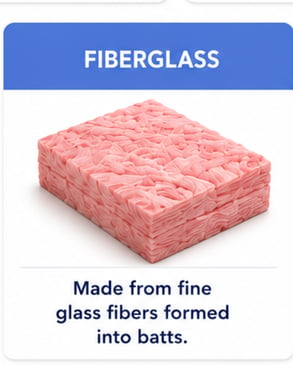 Fiberglass batt and blown insulation is manufactured from molten glass spun into fine fibers, most commonly installed between wall studs or roof rafters.
- Initial R-value: R-2.2 to R-4.3 per inch, depending on density and whether it’s batt or blown.
- Long-term stability: Doesn’t experience thermal drift the way foam does, but its real-world "installed R-value" is notoriously lower than its rated value if it’s compressed, gapped around wiring and boxes, or improperly cut around framing, a well-documented field performance gap that has nothing to do with the material itself and everything to do with installation quality.
- Moisture behavior: Absorbs water readily and dries slowly. Wet fiberglass loses R-value immediately and can create conditions for mold growth if it stays damp.
- Fire: Glass fibers themselves are non-combustible (ASTM E136), one of fiberglass’s genuine advantages, though binders used to hold the batt together can smolder.
- Structural role: None. Fiberglass is a fill material with no load-bearing function.
- Sustainability: Typically 20 to 30% recycled glass content. No blowing agents involved in manufacturing.
- Relative cost: $, the lowest material cost of the seven.
Cellulose
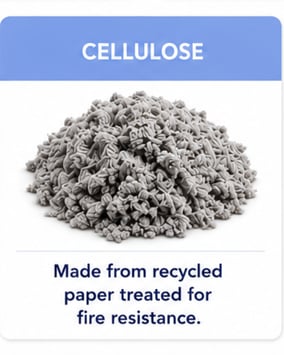 Cellulose insulation is made from recycled paper (largely post-consumer newsprint) treated with borate-based fire and insect retardants, then dense-packed or loose-blown into cavities.
- Initial R-value: R-3.2 to R-3.8 per inch.
- Long-term stability: No thermal drift, but cellulose is prone to settling in open cavities over years, which reduces effective coverage and, in turn, effective R-value at the top of a wall or attic slope. Dense-pack installation largely mitigates this.
- Moisture behavior: Hygroscopic; it absorbs and releases moisture readily. Some building scientists view this as a benefit (it buffers moisture rather than trapping it against a vapor barrier), but sustained saturation causes clumping, sagging, and mold risk.
- Fire: Combustible by nature; fire performance depends entirely on borate treatment, which also provides some insect and rodent resistance.
- Structural role: None.
- Sustainability: The strongest recycled-content story of the seven, typically 75 to 85% post-consumer recycled paper, with low embodied energy and no blowing agents.
- Relative cost: $, low material cost, though dense-pack installation requires specialized equipment.
Mineral Wool (Rock/Stone Wool)
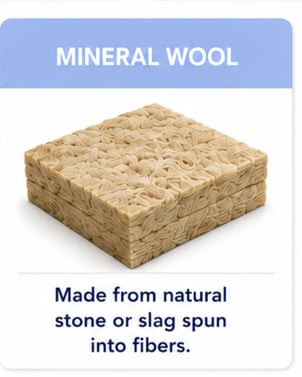 Mineral wool is manufactured by melting basalt rock and/or recycled steel slag at extremely high temperatures and spinning it into fibers, then forming it into batts or rigid boards.
- Initial R-value: R-3.0 to R-4.3 per inch.
- Long-term stability: Inorganic and dimensionally stable; no thermal drift.
- Moisture behavior: Naturally hydrophobic. It sheds water rather than absorbing it and doesn’t support mold growth, a genuine advantage over both fiberglass and cellulose.
- Fire: The strongest fire performance of any material in this comparison. Mineral wool is non-combustible and can withstand temperatures upward of 2,000°F, well above the melting point of fiberglass, which is why it’s frequently specified in fire-rated assemblies without an additional thermal barrier.
- Structural role: None as batt insulation; rigid mineral wool board can serve as continuous exterior insulation, though it isn’t load-bearing.
- Sustainability: Often manufactured with a significant share of recycled slag content (commonly cited around 70%), no blowing agents, and a genuinely strong environmental profile, offset somewhat by the energy intensity of the melting process itself.
- Relative cost: $$, more expensive than fiberglass or cellulose, generally less than rigid foam.
How to Choose the Right Insulation for the Application
None of these materials is universally "best." The right choice depends on where it’s going and what it needs to survive.
Below grade or in contact with soil/concrete for the life of the building: Moisture performance matters more than initial R-value. EPS holds its dimensional stability and moisture resistance in exactly this kind of sustained, damp, load-bearing exposure, which is why it’s a common choice for below-grade and foundation insulation. XPS’s documented below-grade moisture uptake is worth weighing carefully here.
Roofing and continuous exterior insulation: Polyiso dominates commercial roofing for good reason, high R-value per inch and reasonable long-term retention, but its cold-temperature R-value drop matters in northern climates and should be accounted for in energy modeling rather than assumed away.
Fire-rated assemblies, sound-critical partitions, or anywhere non-combustibility is a code driver: Mineral wool’s fire performance is difficult to match with any foam or fiber alternative.
Budget-driven cavity insulation in a standard stick-framed wall: Fiberglass and cellulose remain the lowest-cost options, but both are highly sensitive to installation quality (fiberglass to gaps and compression, cellulose to settling), so the material cost advantage can quietly erode if installation isn’t tightly controlled.
Any application where the insulation also needs to be structural, not just fill space: This is where all seven of the materials above hit the same wall. None of them, on their own, carries a load. That’s a different question entirely, and it’s the one a lot of insulation comparisons skip.
How SIPs Change the Insulation Question Entirely
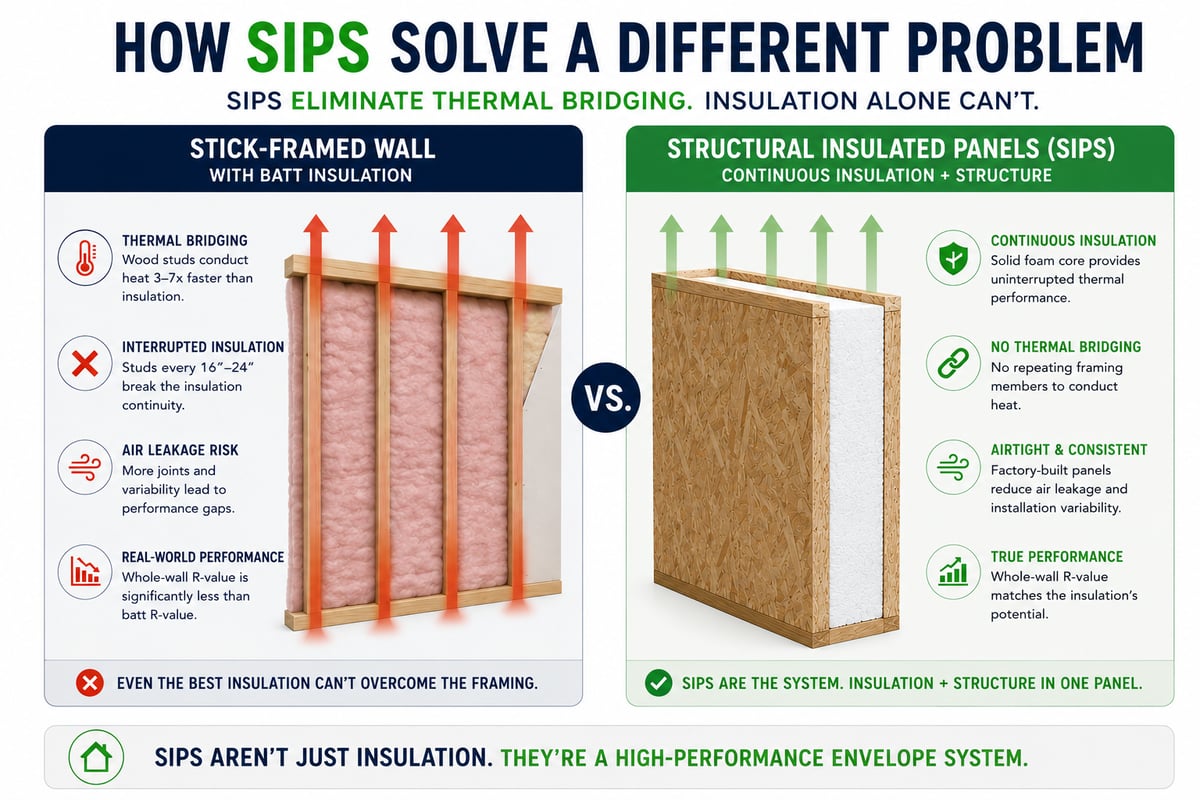
Each material in this guide answers the question: "How well does this insulation perform in a cavity?" It’s a fair question, but it’s the wrong question if the real issue is the cavity itself.
A stick-framed wall interrupts its own insulation every 16 to 24 inches with a stud. Wood conducts heat several times faster than the insulation packed between the studs, so no matter which material fills that cavity, fiberglass, cellulose, or mineral wool, the wall’s real-world performance is capped by thermal bridging that has nothing to do with the insulation’s R-value per inch. Whole-wall R-value testing consistently shows a meaningful gap between a batt’s rated R-value and what the assembly actually delivers once framing, air leakage, and installation variability are factored in.
Structural Insulated Panels (SIPs) solve a different problem than any single insulation material can. SIPs are continuous foam cores, almost always EPS, laminated under pressure between two OSB skins, with no repeating framing members to bridge through and no field-installed insulation whose performance depends on which crew shows up that day. The core material and the framing system are the same panel.
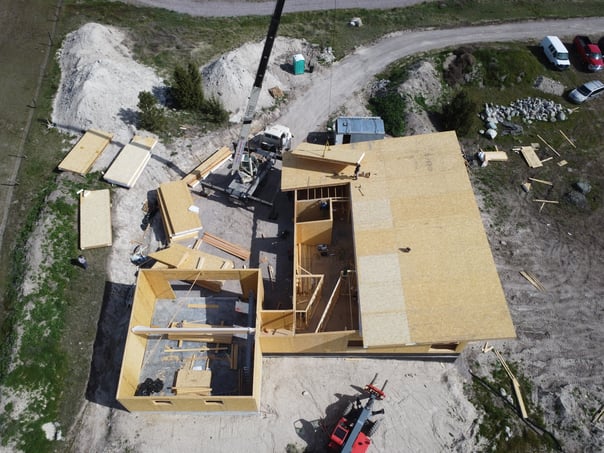 This is why EPS is the material of choice for SIP cores, and it’s a genuinely defensible choice, not just an available one, based on the properties in the table above. It doesn’t experience thermal drift, so the R-value warranted on day one is the R-value still performing in year 30. It’s dimensionally stable under sustained structural load, exactly what a laminated composite panel needs from its core material. It’s 100% recyclable with a manufacturing process free of the ozone-depleting or high-GWP blowing agents that complicate some competing foams. And because it’s laminated between OSB rather than floating in a cavity, it becomes part of the structure rather than a material trying to survive inside one.
Fire performance is worth separating out here too, because the material-level comparison above and the assembly-level performance are two different questions. EPS as a raw material is combustible, like every other foam plastic in this guide. A SIP wall or roof assembly is a different story: with the code-required gypsum thermal barrier installed, as every assembly using any of these insulation types requires, EPS SIP wall and roof sections have passed ASTM E119 one-hour fire-resistance testing.
Premier SIPS also backs this up with third-party verification rather than a manufacturer’s word for it: an industry-wide Environmental Product Declaration for SIPs, and a facility-level cradle-to-gate emissions study. That’s the kind of documentation worth asking for from any insulation or panel manufacturer, regardless of which material ends up in the wall.
Insulation Is One Layer. The Envelope Is the Whole System.
See how a continuous, factory-built SIP envelope changes the thermal bridging and moisture questions this guide raises, before you spec a single material.
Speak with a Premier SIPS Advisor
Frequently Asked Questions
What is the best insulation for a building envelope?
There is no single best insulation across every application. EPS and mineral wool offer the most stable long-term R-value with no thermal drift. Mineral wool has the best fire performance. Polyiso and PUR offer the highest initial R-value per inch but give some of that back over time as blowing agents diffuse out. Cellulose and fiberglass are the lowest-cost options but are more sensitive to installation quality. The right material depends on the application, climate, and moisture exposure.
Which insulation loses R-value over time?
Foam insulations that rely on a trapped gas blowing agent, PUR, XPS, and polyiso, lose some R-value over time as that gas diffuses out and is replaced by air, a phenomenon called thermal drift. Foil-faced polyiso retains roughly 90 to 95% of its labeled value; unfaced PUR and XPS generally see larger declines. EPS and mineral wool do not rely on a blowing agent for their insulating value and do not experience thermal drift.
Why does EPS have a lower R-value than PUR or polyiso but still get used in high-performance construction?
EPS’s initial R-value per inch is lower than PUR or polyiso, but it doesn’t drift downward over time, so its performance is more predictable over the life of a building. EPS also offers moisture stability, structural compatibility as a laminated SIP core, and full recyclability that some higher-R-value foams don’t match. In structural insulated panels, the wall thickness is a design decision that can accommodate EPS’s per-inch R-value while still hitting whole-wall performance targets well above conventional framing.
What insulation is best for below-grade or foundation applications?
EPS is a common choice for structural below-grade and foundation insulation because of its long-term dimensional stability and moisture resistance under sustained exposure. XPS is also used below grade but has documented long-term moisture absorption in field studies that can meaningfully reduce its real-world thermal performance in prolonged wet exposure.
Which insulation has the best fire resistance?
Mineral wool is non-combustible and withstands temperatures above 2,000°F, the strongest fire performance of the common insulation types. Fiberglass fibers are also non-combustible. Foam plastics (EPS, PUR, XPS, polyiso) are combustible to varying degrees and require a code-compliant thermal barrier, typically gypsum board, in occupied assemblies.




.svg)



