



.svg)


The Complete Guide to Building Envelope Insulation Types
A clear, side-by-side comparison of EPS, PUR, XPS, polyiso, fiberglass, cellulose, and mineral wool, ranked on the..
In modern construction, performance is no longer optional.
Energy codes are tightening.
Clients expect lower operating costs.
Mechanical systems are being engineered with greater precision.
And building science is exposing where traditional assemblies fall short.
At the center of all of this is one critical variable:
Airtightness.
Not as a buzzword.
Not as a checklist item.
But as a measurable indicator of whether a building truly performs as designed.
Airtightness directly influences:
But here’s the deeper truth:
Airtightness doesn’t just affect performance — it reveals whether a building is a coordinated system or a collection of layered parts.
And in today’s construction environment — where labor variability, compressed schedules, and performance verification are the norm — how airtightness is achieved matters just as much as the final ACH number.
For architects and builders pursuing high-performance results, airtightness is not a detail to patch at the end. It is a design decision made at the beginning.
Before Diving Into Airtightness, It Helps To Understand How Building Envelopes Perform as Systems ⇒ Why the Best Building Envelopes Are Designed to Work Together as a System
Airtightness refers to how well a building’s enclosure resists uncontrolled air leakage between the interior and exterior.
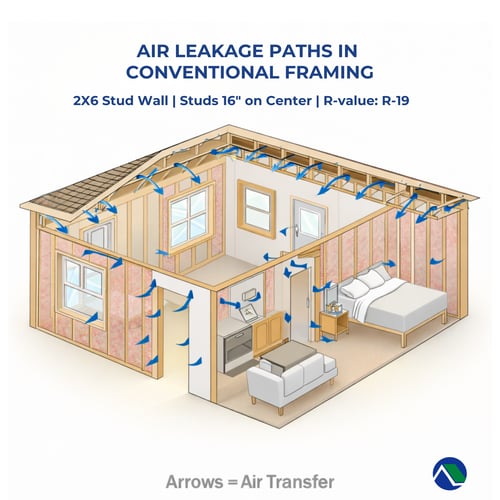 In simple terms:
This uncontrolled air movement affects:
It’s important to clarify:
You can have high R-values and still have a leaky enclosure.
A truly high-performance building requires both thermal resistance and air barrier continuity.
Airtightness is verified through a blower door test.
During testing:
The result is expressed as:
ACH50 — Air Changes per Hour at 50 Pascals
This number indicates how many times the total volume of air inside the building is replaced in one hour under test pressure.
Did You Know: Real-world SIP projects routinely test below 2 ACH50, and many high-performance SIP buildings achieve airtightness results in the 0.5–1.0 ACH50 range when properly detailed and installed. That level of performance is consistent with high-performance building programs and Passive House benchmarks (≤0.6 ACH50).
Typical ranges:
For architects and engineers, ACH50 directly impacts:
For builders, blower door testing is where performance claims are verified.
Airtightness is no longer theoretical — it is measurable and documented.
Targeting a Specific ACH50 for Your Project?
If your project has a performance target — whether code-minimum or high-performance — our team can review your enclosure approach and discuss realistic pathways to achieve it.
Airtightness should be designed in — not added on after the fact.
Too often, airtightness becomes a late-stage correction:
When airtightness is treated as a field fix, it becomes reactive rather than intentional.
High-performance buildings take a different approach. They treat airtightness as a system-level enclosure strategy defined during schematic design and coordinated across:
When airtightness is embedded into the structural system itself, it reduces:
The result is not just a better test number. It is a more predictable outcome. Airtightness is not something to “patch.”
It is something to engineer.
Airtightness influences far more than a single test result.
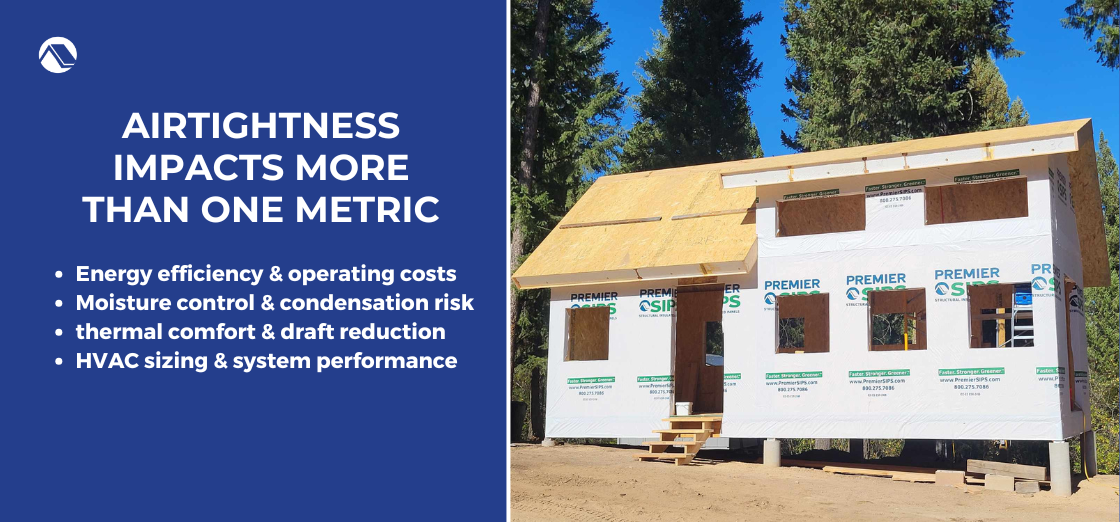
It directly affects:
Three major forces have elevated airtightness from “best practice” to essential design strategy:
Modern energy codes increasingly require verified air barrier performance through blower door testing. Design assumptions must now withstand field measurement.
Programs such as LEED, Net-Zero Certified & Passive House require extremely low infiltration rates, leaving little room for execution variability.
Both commercial and residential owners expect things that an airtight envelope delivers, including:
Airtightness is the bridge between modeling and lived performance.
But how airtightness is achieved matters just as much as the final number.
Did You Know?
SIP-built structures have been shown in DOE and ORNL testing to be up to 15× more airtight than traditional stick framing with batt insulation, significantly reducing uncontrolled air leakage and supporting tighter thermal control.
In conventional construction, airtightness is largely dependent on jobsite coordination. Air control is spread across multiple layers, installed at different times, and handled by different trades. Framing, sheathing, weather barriers, insulation, and interior finishes are often completed in separate phases, sometimes weeks apart. Each handoff introduces risk.
Every transition between materials creates an opportunity for continuity to break down. Individually, these gaps may seem minor. Collectively, they can undermine airtightness across the entire building envelope. Common risk areas include:
When airtightness depends heavily on field execution, variability increases — and that variability shows up during blower door testing.
Late-stage air sealing fixes can add cost and schedule pressure. The growing reliance on interior-applied air sealing systems reflects this reality. These solutions are often used to compensate for air leakage that originates from fragmented envelope assemblies rather than poor materials.
When airtightness must be corrected late in the construction process, it’s usually a sign that air control was treated as a layer to be added, not a system designed from the start.
For builders, that introduces uncertainty.
For architects, that introduces performance deviation.
Airtightness Challenges Often Start With How Walls Are Framed. Explore How Conventional Assemblies Introduce Hidden Complexity ⇒ The Hidden Cost of Studs
Understanding the strategic difference between layered and integrated systems is essential. Most projects pursue airtightness using one of two approaches. Both can work, but they differ significantly in how airtightness is achieved and maintained.
This method builds airtightness by combining multiple materials in the field. (Stick framing + taped sheathing such as ZIP System + insulation)
Products such as the Huber ZIP System are designed to function as both structural sheathing and a weather-resistive barrier, with taped seams forming the air barrier when installed correctly. Taped sheathing systems like ZIP represent an improvement over traditional house wrap because the air barrier is integrated at the sheathing plane and seams are mechanically sealed. These ZIP System have been shown to reduce air leakage by roughly 25–40% compared to traditional taped house wrap and untreated OSB, provided seams and penetrations are meticulously detailed in the field.
Advantages:
Limitations:
Airtightness becomes a coordination challenge.
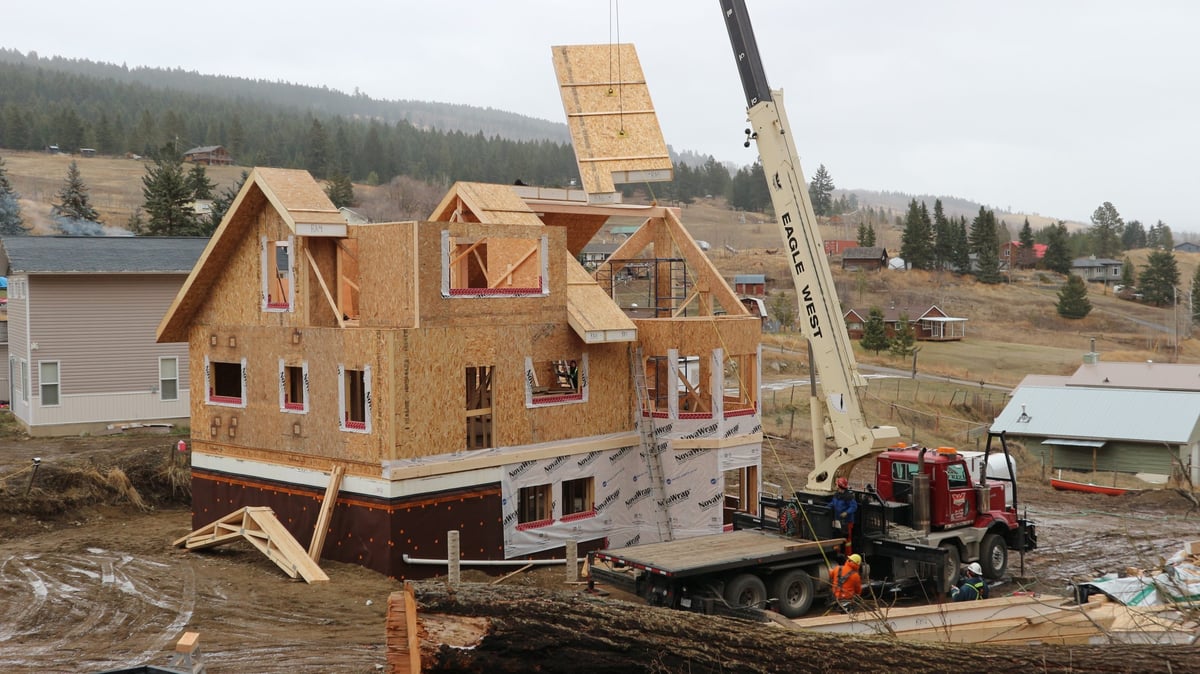
Structural insulated panels are a panelized construction system that integrate structure, insulation, and sheathing into one engineered assembly. Manufactured offsite, in a controlled factory environment, panels arrive to job sites pre-cut to exact floor plans,
Advantages:
This reduces:
Instead of assembling performance layer by layer on site, airtightness becomes inherent to the system.
For builders and architects focused on predictable performance and reduced risk, that distinction matters.
Disadvantages:
Both system-based and layered assemblies can achieve strong airtightness when properly executed.
However, real-world blower door results show that:
The comparison below outlines where these approaches differ in predictability, coordination, and long-term risk exposure.
| Performance Variable | ZIP System + Framed Wall Assembly | Integrated SIP Enclosure System |
|---|---|---|
| Air barrier location | Multiple potential layers | Integrated within structural panel |
| Number of seams | High (stud spacing + sheathing seams) | Reduced (large-format panels) |
| Air barrier continuity | Achieved through field coordination | Engineered into panel system |
| Dependence on taping | Extensive | Limited to panel joints |
| Dependence on field labor precision | High | Moderate (focused at joints) |
| Trade overlap at air barrier | Significant | Reduced |
| Risk at penetrations | High | Reduced (planned joint sealing) |
| Blower door variability | Often variable | More consistent when detailed properly |
| Late-stage corrective sealing | Common | Less frequent |
| Modeling predictability | Dependent on execution | More reliable |
| HVAC load stability | Can vary | More stable |
| Moisture transport risk | Higher if continuity fails | Reduced through fewer transitions |
| QA/QC burden | Higher | More controlled |
| Long-term durability risk | Increased with discontinuities | Reduced through system continuity |
| Strategy type | Layered assembly approach | System-based enclosure strategy |
This is not about preference.
It is about predictability and risk management.
High-performance teams do not just pursue airtight buildings.
They pursue repeatable airtight results.
Note: systems-based airtight design does not remove the need for skilled labor. It supports it. Installers spend less time compensating for misalignment or correcting gaps and more time executing a clear, coordinated plan.
Evaluating SIPs vs Framed Wall Assemblies?
See how SIP wall systems are detailed and installed — including panel joints, transitions, and connection details.
Architects and builders frequently ask:
“How do SIP assemblies compare to ZIP System walls in terms of airtightness?”
The ZIP System combines structural sheathing with a factory-applied WRB layer and relies on taped seams to establish air and water control.
When properly installed and taped, ZIP System assemblies can achieve good airtightness results.
However, airtightness in ZIP-based assemblies depends on:
In other words, performance is highly dependent on field execution.
By contrast, SIP assemblies:
This does not mean ZIP assemblies cannot perform well.
It means that the path to airtightness differs:
For teams pursuing high-performance targets — particularly below 2.0 ACH50 — reducing seams and transition points becomes increasingly important.
Airtightness becomes easier to achieve when there are simply fewer opportunities for discontinuity.
Airtight Envelopes Help Reduce Energy Demand For The Life Of The Building
Infiltration is a major input in energy modeling.
When air leakage is reduced:
Excess infiltration forces conservative mechanical sizing to compensate for uncertainty.
This often leads to:
A stable enclosure enables mechanical systems to operate as designed.
Designing for Verified Performance?
If airtightness, HVAC optimization, or high-performance certification is part of your project goals, start the enclosure conversation early.
Airtightness directly impacts occupant comfort.
Reduced uncontrolled air movement results in:
Comfort consistency is often the most noticeable benefit of a high-performance enclosure.
Air carries moisture.
When uncontrolled air moves through wall and roof assemblies, moisture follows.
Over time, this can lead to:
A well-designed airtight enclosure reduces moisture transport at its primary pathway — uncontrolled airflow.
Durability begins with air management.
If your project goals include:
Airtightness strategy must be addressed during schematic design — not after framing.
The enclosure is not a collection of materials.
It is a system.
Explore Verified Studies That Show How SIPs Deliver Measurable, Long-Term Results
⇒ Proof in Performance Series
Airtightness has earned its place in conversations about building performance, and it is a proven lever for energy efficiency, comfort, moisture control, and durability. But it works best when it’s treated as a design strategy, addressed during schematic design — not a jobsite challenge after framing.
Airtightness is not about choosing better tape.
It is about choosing an envelope strategy. The enclosure is not a collection of materials. It is a system.
For teams prioritizing:
The difference between field-assembled airtightness and integrated airtightness becomes significant.
Layered, field-applied systems can perform well when executed meticulously. However, airtightness that relies on perfect execution at every step is inherently more vulnerable.
System-based assemblies reduce variability, risk and simplify performance outcomes.
Want to design higher-performing, airtight buildings with confidence?
Airtightness is measurable.
The strategy you choose determines the result you deliver.
What is airtightness in construction?
It is the resistance of a building enclosure to uncontrolled air leakage.
Why is airtightness important in building design?
Airtightness controls unintended air movement, which affects energy use, moisture transport, comfort, and HVAC performance.
How is airtightness measured?
Through blower door testing, expressed as ACH50.
Is airtightness just about passing a blower door test?
No. Blower door tests measure results, but airtightness is created through envelope design and continuity.
What airtightness level should I target?
Targets vary by project goals, climate, and code, but designers often reference standards like Passive House (e.g., ≤ 0.6 ACH50) as high-performance benchmarks.
What ACH50 is considered high performance?
1.0–2.0 ACH50 is common for high-performance construction. Many advanced programs aim for ≤2 ACH50, with Passive House targeting ≤0.6 ACH50. Appropriate targets depend on climate zone and project goals.
How do SIPs achieve airtightness differently than traditional framing?
SIPs integrate structure, insulation, and air control into a single system, reducing seams and reliance on field-applied air barriers.
Is taped sheathing like ZIP effective for airtightness?
Yes. Taped sheathing systems can significantly improve airtightness compared to untaped sheathing and house wrap when properly installed. Performance depends heavily on detailing and field execution.
Do SIPs eliminate the need for air sealing?
No. Proper detailing at panel joints and penetrations is still required. However, the number of required field seams is typically reduced compared to layered assemblies.
Does airtightness mean no ventilation?
No. Airtight buildings require controlled ventilation to ensure air quality and remove pollutants without losing thermal performance.
Do SIP buildings still require ventilation?
Yes. Airtight envelopes require intentional, controlled ventilation to maintain indoor air quality.
Can airtightness reduce HVAC system size/costs?
Yes. Predictable airtightness reduces heating and cooling loads, allowing HVAC systems to be sized more accurately, improving efficiency and reducing equipment costs.
How does airtightness affect moisture control?
Air leakage carries moisture into assemblies. Reducing uncontrolled air movement helps limit condensation and durability issues.

Premier SIPS deliver a high-performance building envelope that outperforms traditional framing in efficiency, strength, and long-term durability. If you're evaluating SIPs, planning an upcoming project, or ready for pricing, now is the time to talk with our team about the right next step.
