



.svg)



Weather Delays in Construction and How to Shrink the Exposure Window
Every week a framed structure sits exposed to weather is real financial risk. See what that risk actually costs and how to..
SIP construction changes the cost conversation. Instead of pricing a material, you're pricing a system — one that combines structure, insulation, and air sealing into a single factory-fabricated panel. That changes how labor, schedule, and long-term performance factor into the total project number.
SIPs are not more expensive. Poorly designed projects are.
This article breaks down SIP panel pricing, compares total project cost against traditional framing, and explains what drives long-term savings — so you can evaluate SIPS as a system, not just a material.
Cost is one of the first questions builders, architects, developers, and owners ask when evaluating SIPS. The answer depends on more than panel pricing — but here's where to start.
SIP panel pricing varies based on project design, location, panel thickness, and performance requirements. The ranges below provide a general benchmark.
| COMPONENT | COST RANGE |
| SIP Panels (fabricated + drafting) | $10 - $16 per sq ft |
| With Engineering (if required) | $10 - $17 per sq ft |
| Freight (typical average) | + $1 per sq ft |
For context: when labor, insulation, and sheathing are factored into a comparable stick-framed assembly, the net material cost difference is often smaller than builders expect. A full project quote is the most accurate way to evaluate cost — panel price alone doesn't tell the complete story.
Understanding what's in — and what's not in — a SIP panel quote prevents budget surprises downstream.
 Included in standard SIP panel pricing:
Available Upgrades:
 Several variables affect where your project lands within the pricing range:
SIP pricing reflects a system, not a single material. Projects that are designed with SIPS from the start — with panel dimensions and layouts optimized during design — consistently achieve better cost outcomes than those where SIPS are introduced late.
* Panels are available in nominal 4", 6", 8", 10" and 12" thicknesses. Premier SIPS come standard with EPS solid insulation cores (white color), however higher R-value GPS insulation cores (made with graphite for a grey color) are a regular upgrade, and often facilitate thinner walls and roofs.
Builders don't just build with materials. They build with systems.
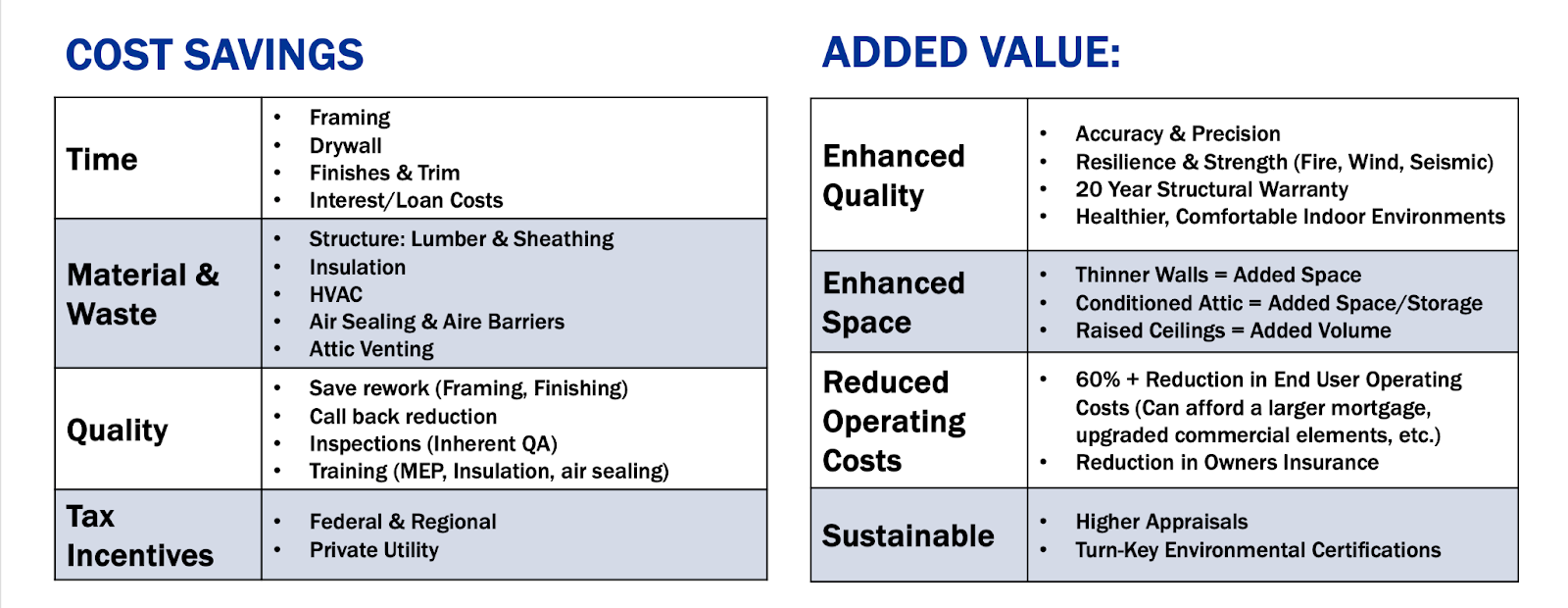
Traditional construction builds the enclosure in layers — framing, then insulation, then air sealing, each step dependent on the one before it. SIPS deliver the enclosure as one integrated system. That difference affects how a project is built, how long it takes, and how consistently it performs.
Because structure, insulation, and air sealing are combined into a single panel, fewer steps are required on site. That reduces labor, simplifies trade coordination, and improves overall predictability.
For developers, owners, and decision-makers, this translates directly into total project cost, timeline reliability, and long-term building performance.
Cost is not just what you spend on materials. It is what you spend to complete the building.
⇒ New To SIPS? Start Here: What Are Structural Insulated Panels?
Comparing SIPS to traditional stick framing is not a material-to-material comparison. Each approach represents a fundamentally different way of building the enclosure.
| CATEGORY | SIP CONSTRUCTION | STICK FRAMING |
| Materials | Higher upfront | Lower Upfront |
| Labor | Reduced | Higher |
| Schedule | Faster | Slower |
| Waste | Minimal | Higher |
| Performance | Consistent | Variable |
| Price Certainty | Fixed | Fluctuates with materials market |
Traditional framing builds the enclosure in pieces. SIPS construction delivers it as a system. That difference reduces variability, rework, and coordination complexity — and variability is one of the most expensive parts of construction.
Fair question. Here's how it plays out in real projects.
Materials: SIPS replace separate purchases for framing lumber, batt insulation, spray foam, and OSB sheathing in a single factory-engineered panel. On a full building envelope, the net material cost difference is often smaller than builders expect.
Labor: This is where SIPS win decisively. Faster enclosure means fewer crew-days on site, less exposure to weather delays, and earlier mechanical rough-in. You cannot put a number on a crew that doesn't show up for three weeks — but you can price the risk of it. SIPS arrive ready to install on a fixed timeline.
Price certainty: Unlike stick framing, where lumber and hardware costs fluctuate daily, your SIPS quote is your final cost. That predictability alone changes how you bid and how you manage project risk.
Performance: A SIPS building envelope outperforms stick frame on air infiltration, thermal bridging, and long-term energy loads. You're delivering a tighter, stronger, more efficient building — without the labor-intensive extras traditional framing requires. That's a differentiator for your business and a selling point for your buyers.
Quiet: The continuous insulation core in a SIPS panel dramatically reduces sound transmission compared to stud-framed walls with batt insulation. For homeowners, that means a noticeably quieter living environment. For builders, it's a tangible quality differentiator that buyers feel the first time they walk through the door.
Healthy: Because SIPS create a tighter, more controlled building envelope, fresh air enters where you design it to — not through gaps in the framing. That means better indoor air quality, reduced allergen and pollutant infiltration, and a more comfortable, healthier interior environment for occupants.
Energy efficiency: SIPS consistently achieve 40–60% lower energy use compared to conventional framing. Continuous insulation eliminates thermal bridging. A tight air barrier reduces energy loss. Smaller HVAC systems meet load. And with solar, renewable energy, or advanced building detailing, SIPS buildings regularly reach net-zero or positive energy construction — delivering a building that produces as much energy as it consumes, or more.
So are SIPS worth it?
A stronger structure. A quieter home. A healthier indoor environment. A more energy efficient building. Delivered faster, at a predictable cost, with fewer variables in the field.
The better question is: why build with less?
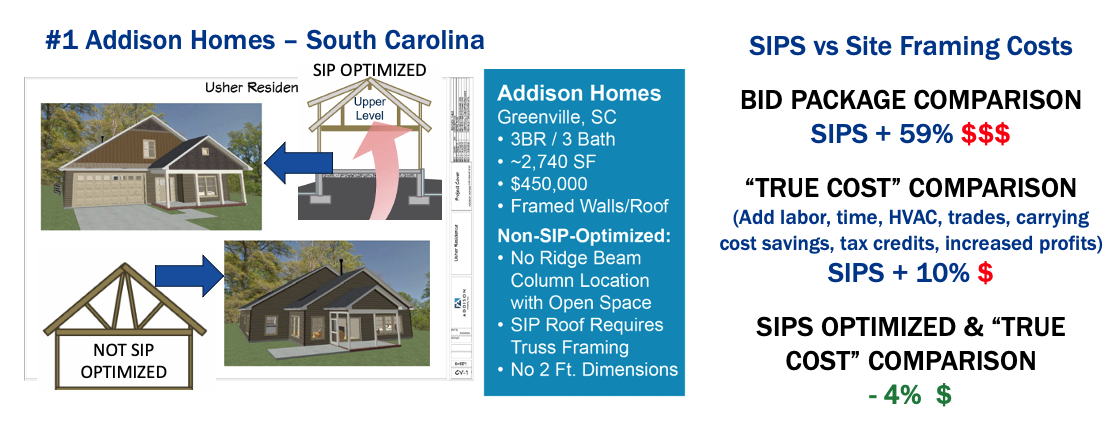
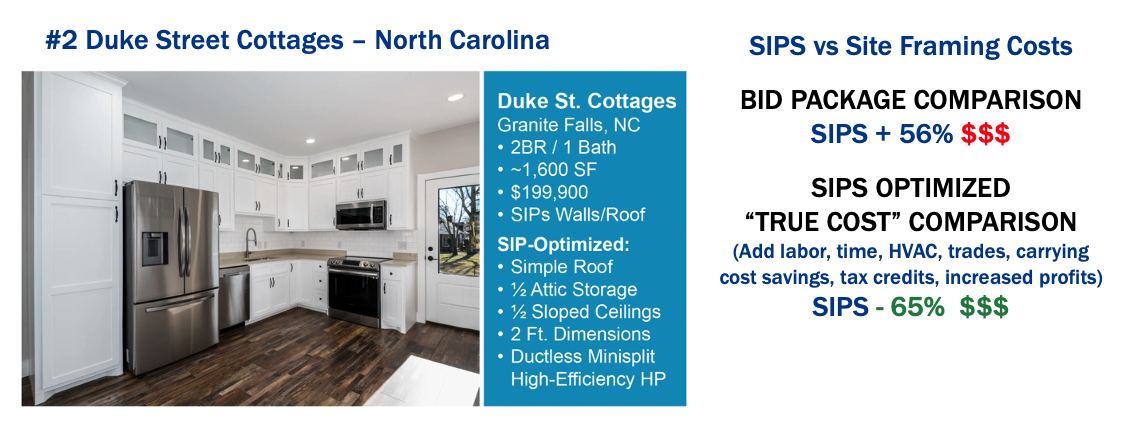
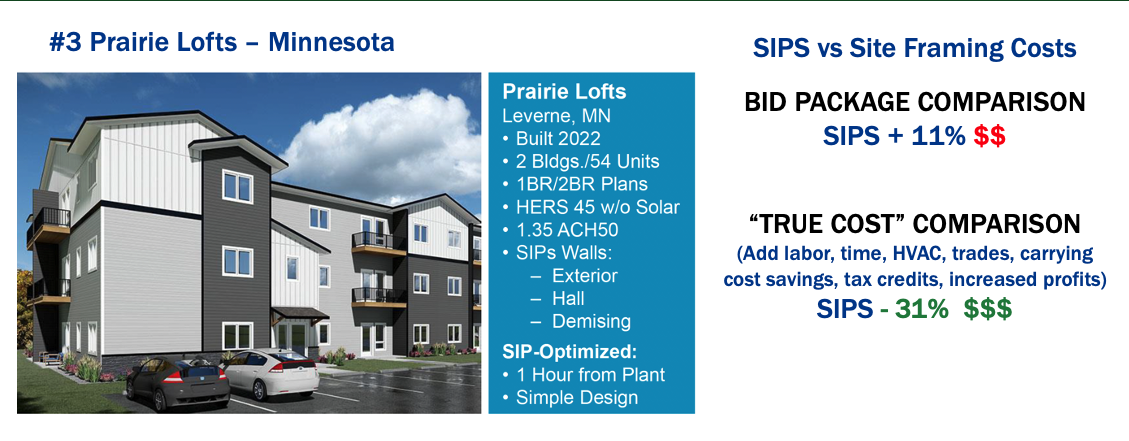
The following comparisons are based on real construction projects analyzed through a cost comparison program developed by the Structural Insulated Panel Association (SIPA), with guidance from building science expert Sam Rashkin. These studies evaluate full system costs — materials, labor, construction time, financing, and long-term performance — not just panel pricing.
Across multiple projects, initial material premiums for SIPS were offset or reversed once full system costs were considered.
Addison Homes, led by high-performance builder Todd Usher in Greenville, South Carolina, evaluated SIPS on a 2,740 sq ft custom home priced at $450,000. Three SIP companies were bid against conventional framing estimates, factoring in insulation, air sealing, cycle time, and long-term performance.
The takeaway: design optimization is the variable that flips the cost equation. A plan designed for SIPS from the start outperforms one where SIPS are retrofitted into a conventional layout.
Rob Howard, building science expert and Appalachian State University faculty, developed Duke Street Cottages in Granite Falls, NC — DOE Zero Energy Ready Homes priced at $199,900. SIPS were used to optimize space and efficiency in an affordably priced high-performance home.
This project demonstrates what's possible when SIPS are integrated into design from the beginning on a performance-focused, cost-conscious build.
Greensmith Builders, led by Aaron Smith, Executive Director of EEBA (Energy Efficiency Building Alliance), constructed Prairie Lofts in Laverne, Minnesota — a U.S. DOE Zero Energy Ready multifamily project using SIPS for walls with conventional roof framing.
At multifamily scale, the labor and performance efficiencies of SIPS compound significantly. This project makes the case for SIPS on larger developments where schedule compression and envelope consistency directly impact the bottom line.
Material cost is only part of the equation.
Traditional framing is often evaluated on lumber and insulation pricing alone. But the full cost of building the enclosure extends well beyond materials — because conventional construction is assembled on site, it introduces layers of variability that show up in labor, schedule, and long-term performance.
These costs don't always appear in initial estimates. They show up during construction and over the life of the building.
Where hidden costs come from:
Field-built systems require constant adjustment, and small issues compound quickly. A framing delay impacts insulation. Insulation gaps affect air sealing. Air sealing interruptions show up in energy bills and blower door tests — often months after the project closes.
Field-built systems create variability. Variability creates cost.
⇒ The Hidden Costs of Studs: How SIPS Cut Energy Use and Saves Days on Your Build
SIP construction shifts the conversation from upfront cost to total cost of ownership.
Because SIPS panels provide continuous insulation and a tight air barrier, they maintain thermal performance over time — reducing uncertainty in energy use and keeping the building performing as designed for decades.
SIPS buildings typically deliver:
Over time, those performance characteristics translate into lower monthly utility costs, reduced maintenance, more predictable operating expenses, and higher long-term asset value.
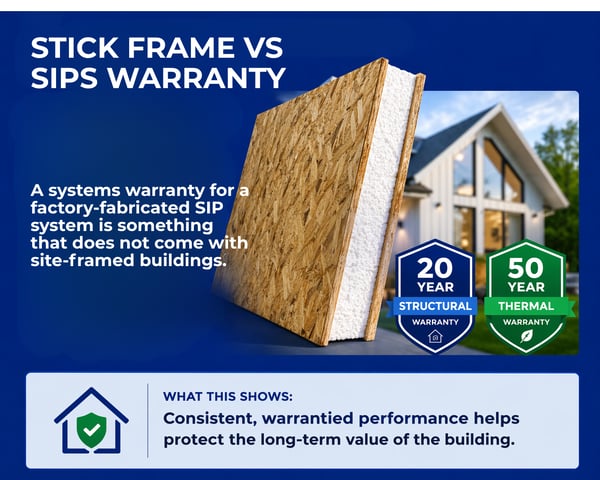
Premier SIPS panels are backed by a 20-year structural warranty and a 50-year thermal warranty — reflecting the long-term durability and consistent performance of the SIPS building envelope. Traditional stick-framed assemblies rely on field installation across multiple materials, making long-term performance harder to predict and harder to guarantee.
 Energy efficiency is one of the most significant — and most frequently underestimated — cost advantages of SIPS construction.
Traditional framed buildings lose energy through thermal bridging, air leakage, and inconsistencies in how insulation is installed. Even well-built framed walls contain studs and gaps that interrupt the insulation layer and allow conditioned air to escape.
SIPS address this by creating a more continuous and airtight building envelope. Because structure, insulation, and air sealing are fabricated together, there are fewer opportunities for energy loss between components.
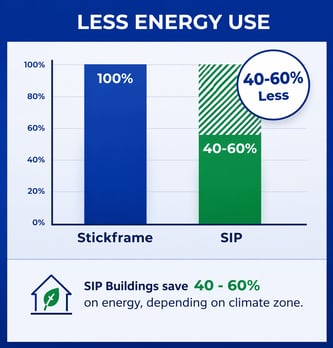
SIPS buildings typically achieve 40–60% lower energy use compared to conventional framing, depending on design and climate. With solar, renewable energy integration, or advanced detailing, that performance baseline makes net-zero and positive energy construction not just achievable — but straightforward."
Lower energy use leads to:
For developers and building owners evaluating total cost of ownership, energy performance is not a feature — it's a financial variable.
It's common to assume lower material costs lead to lower overall project costs. In construction, that assumption is expensive.
Traditional framing may appear less expensive upfront, but it requires multiple steps, trades, and coordination passes to complete the building enclosure. Each step adds labor, time, and the potential for variability. Lower material cost often shifts cost into:
SIPS simplify this process. Fewer steps on site lead to reduced labor hours, faster enclosure, and more consistent installation. Over the course of a project, those efficiencies frequently offset or exceed the initial material cost difference.
Cost is not just what you spend on materials. It is what you spend to complete the building.
SIPS are not the right solution for every project — and understanding when they're not the best fit helps ensure they're used where they deliver the greatest value.
SIPS may not be the best choice if your priority is:
Projects that rely heavily on field adjustments, last-minute changes, or fragmented trade coordination may not realize the efficiencies SIPS are designed to provide. If the focus is strictly on lowest upfront cost or maintaining traditional methods, conventional framing may be the more familiar path.
Choosing the right building system starts with being honest about project priorities.
 SIPS deliver the most value when a project is designed with performance, efficiency, and predictability in mind.
SIPS are often the better investment when a project requires:
Commonly used in:
For architects, early coordination with a SIPS manufacturer means panel dimensions can be integrated into the design from the start — preserving design intent while optimizing for efficiency, structural performance, and cost. SIPS don't constrain design. They make it buildable.
For developers and project owners evaluating total cost of ownership and long-term asset performance, SIPS consistently deliver greater value through improved efficiency, reduced variability, and more predictable outcomes.
SIPS deliver the most value when they're considered early in the design process. Because SIPS are a prefabricated system, design decisions directly impact how panels are manufactured, delivered, and installed.
When SIPS are introduced late, projects often require redesign, field adjustments, or compromises that reduce the cost and performance advantages the system is designed to provide.
Early design and pre-planning help:
Projects designed with SIPS from the beginning consistently achieve better cost outcomes, faster timelines, and more consistent performance. SIPS are not a drop-in product. They are a design-driven system.
In practice, this means simplifying building geometry where possible, aligning structural spans with panel dimensions, and coordinating connection details before panels are fabricated. This doesn't limit design flexibility — it ensures the design translates efficiently from drawings to construction.
⇒ From Blueprints to Build: Optimizing Superior Designs With SIPS
One of the most significant — and least discussed — advantages of SIPS pre-planning is parallel construction.
In traditional site-built construction, each phase waits for the previous one to finish. Framing can't start until the foundation is complete. Insulation waits on framing. Air sealing waits on insulation. Every step is sequential, and every delay cascades.
SIPS construction breaks that chain. While site development and foundations are underway, panels are being fabricated in the factory. By the time the foundation is ready, the building enclosure is ready too. Installation and site restoration happen in a compressed window — not a sequential one.
The result is a shorter overall construction cycle, less second-guessing in the field, and a faster path to dry-in and mechanical rough-in. The upfront planning investment doesn't add time to the project. It compresses it.
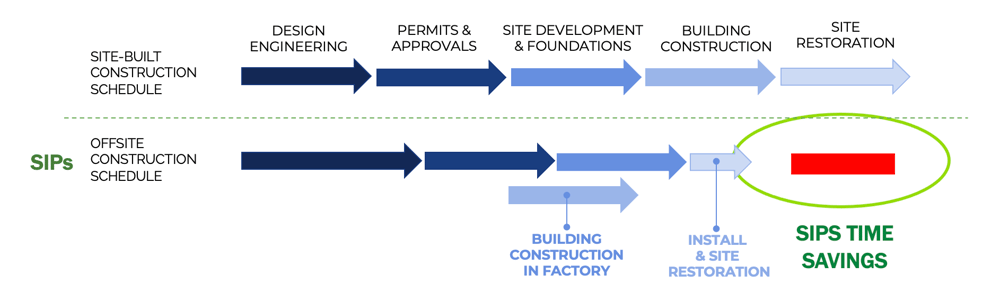
While site-built construction waits at every phase, SIPS panels are being fabricated in parallel — so when the foundation is ready, the building enclosure is too.
⇒ How Smart Pre-Construction Planning Leads to Better SIPS Builds
Once a project is properly designed and planned, execution is the next critical factor in controlling cost and risk. Successful SIPS projects are not just about the materials — they're about how the system is executed.
Key ways builders reduce cost and risk with SIPS:
This approach shifts more work into a controlled manufacturing environment and reduces uncertainty on the jobsite. The result is a more predictable construction process with fewer delays, fewer surprises, and better overall outcomes.
⇒ The Premier SIPS Process: What to Expect for a Successful Build
Understanding SIP construction cost starts with looking beyond materials and evaluating the building as a complete system.
Total project cost is shaped by design decisions, labor efficiency, construction timelines, and long-term performance. When those factors are considered together, SIPS construction consistently delivers greater value through improved efficiency, reduced variability, and more predictable outcomes.
Every project is different. The best way to understand how SIPS apply to your specific goals is to evaluate your design, timeline, and performance priorities early — before decisions get made that are harder to undo.
How much do SIP panels cost per square foot? SIP panels typically range from $10 to $16 per square foot, depending on panel thickness, project design, engineering requirements, and location. Delivery and accessories are typically additional.
Are SIPs more expensive than stick framing? SIP panels carry a higher upfront material cost than traditional framing. However, when labor, construction time, price certainty, and long-term energy performance are factored in, total project costs are often comparable or lower — particularly on projects designed for SIPS from the start.
What is the biggest cost advantage of SIP construction? Labor and schedule. SIPS arrive fabricated and ready to install on a fixed timeline, reducing crew-days on site, minimizing weather exposure, and enabling earlier mechanical rough-in. Combined with fixed pricing — unlike lumber, which fluctuates daily — SIPS significantly reduce project cost risk.
Do SIP buildings really save energy? Yes. SIPS buildings typically achieve 40–60% lower energy use compared to conventional framing due to continuous insulation and a tight air barrier across the full building envelope. With solar, renewable energy, or advanced detailing, SIPS buildings regularly achieve net-zero or positive energy construction.
Can SIPs reduce construction time? Yes. Because SIPS panels are prefabricated offsite and delivered ready to install, builders typically complete the building enclosure faster than with traditional framing — reducing overall project timelines, loan carry costs, and weather exposure.
Do SIPs cost more in cold climates? Not necessarily. SIPS often deliver greater value in cold and climate-sensitive regions because continuous insulation and airtight construction have a more significant impact on energy performance and operating costs. The higher the heating and cooling demand, the more the long-term savings compound.
Are SIPs harder to build with? SIPS require more upfront planning than traditional framing, but installation is straightforward for crews who follow the engineered panel sequence. Most builders report faster enclosure times on their second SIPS project as the system becomes familiar.
Do SIPs require special design considerations? Yes. SIPS construction benefits from early design coordination to optimize panel layouts, reduce waste, and improve installation efficiency. Projects designed with SIPS from the beginning consistently achieve better cost and performance outcomes.
When are SIPs the best choice for a project? SIPS are a strong fit for projects that prioritize energy efficiency, faster construction timelines, reduced labor complexity, price certainty, and long-term building performance — particularly custom homes, multifamily, and high-performance or net-zero projects.
What is included in SIP panel pricing? Standard SIP panel pricing typically includes fabricated panels, shop drawings, panel layout, and basic installation accessories. Engineering, delivery, crane services, and project-specific requirements are typically quoted separately.

Premier SIPS deliver a high-performance building envelope that outperforms traditional framing in efficiency, strength, and long-term durability. If you're evaluating SIPs, planning an upcoming project, or ready for pricing, now is the time to talk with our team about the right next step.
